
Google Traffic Analysis: Where Are Visitors Coming From?
When you look at access logs, there's a spot that tells you where visitors came from. It's called the Referrer. If you see https://www.google.com/ listed there, it usually means the person clicked on a Google search result to get to your site. Traffic statistics are typically built by counting entries in this spot.
Over an eight-day period on this server, there were 34,446 requests that listed a search engine in the Referrer field. Just looking at the numbers, that translates to about 4,300 visitors coming from search engines per day. However, after I excluded four specific categories, only 19 of those could possibly be real people. That's just 0.06%.
The Logs Say Google
First, I just tallied up every address listed in that field. If I count them without any suspicion, this is the report you get.
| Referrer URL | Requests |
|---|---|
| www.google.com | 33,814 |
| m.baidu.com | 220 |
| duckduckgo.com | 127 |
| www.bing.com | 112 |
| google.com | 60 |
| yandex.ru | 55 |
| www.baidu.com | 49 |
| www.google.com.hk | 6 |
| www.google.co.uk | 2 |
| search.naver.com | 1 |
| Total | 34,446 |
Google accounts for 98.4% of this traffic. And only one request came from Naver. It’s strange that there’s only one entry from a domestic search engine on a server hosting Korean sites.
What I Found After Looking at the Data
The "Referrer" isn't something the server figures out. It's a value sent by the party making the request. So, even if it's fake, the server just logs what it receives. To see if you can trust it, you have to cross-reference it with other parts of the same request.
96.4% of the Requests Were for Non-Indexable Pages
I categorized the requested paths.
| Requested Path | Count |
|---|---|
| Category/Sort URLs | 32,547 |
| Other | 1,306 |
| xmlrpc.php | 224 |
| Homepage | 141 |
| Settings/Backup File Browsing | 106 |
| WordPress Directory Browsing | 102 |
| wp-login.php | 14 |
| REST API | 5 |
| Article Content | 1 |
There were 224 requests coming in as if they were from Google, but they were hitting the xmlrpc.php file. This address isn't a human-readable page, and it won't show up in search results. I also found 106 requests looking around at configuration and backup files. And 14 requests went to the login page.
The biggest chunk, 32,547 requests, were for category URLs. These made up 96.4% of all requests, and they all had query parameters attached. These were URLs with different sorting criteria and page numbers. A clean URL that actually shows up in search results is for a single article, and those types of URLs usually come from browsing through a list. Only 1 out of the 34,446 requests went to the actual article content.
96.0% of Requests Came From a Single IP Block
I grouped the source addresses into larger blocks.
Out of 34,446 requests, 33,085—that’s 96.0%—came from just one block: 47.79.0.0/16. Within that block, they were clustered into seven /24 segments. If these were people searching from homes and phones across the country, their addresses wouldn't be grouped up like this. When I did a reverse lookup on a few of these IP addresses, they weren't registered to any specific names. Personal connections usually have the name of the service provider attached.
Each individual IP address sent an average of 44.7 requests. A person who came in via search wouldn't typically read 44 pages and then leave all at once.
Traffic Was Consistent: 469 Requests Per Hour
I broke down the busiest day, October 8th, into hourly segments. I excluded the hour around midnight because that's when log files get rotated.
The traffic averaged 469 requests per hour, with a low of 435 and a high of 553. The difference between the busiest and quietest hours was only 1.27 times. Human traffic usually spikes in the evenings or very early mornings, causing big swings throughout the day. Keeping traffic steady within a 1.27x range over 23 hours suggests this traffic wasn't generated by people.
Only 9.0% of IPs Were "Acquiring" Assets
When a browser loads a page, it downloads all the accompanying CSS, JavaScript, and images. It has to render the screen, so it can't skip them. On the flip side, bots that only scrape the main content don't grab all that extra stuff. I compared this behavior to actual visits from real people.
| Category | IP Count | IPs that downloaded assets | Percentage |
|---|---|---|---|
| Requests mentioning search engines | 770 | 69 | 9.0% |
| Requests from visitors to my two blogs | 702 | 287 | 40.9% |
Only one out of the requests claiming to be from Google actually rendered the page; the other nine just grabbed the HTML and stopped.
What's Left: Only 19 Visits
Based on the observations above, I applied a series of filters to narrow down the results. I didn't look at the Referrer information at all.
| Filter Applied | Remaining Requests | Percentage |
|---|---|---|
| All requests mentioning search engines | 34,446 | 100% |
| Only IPs that downloaded assets | 504 | 1.46% |
| Plus, fewer than 10 requests per IP | 145 | 0.42% |
| Plus, URLs without conditions after a question mark | 19 | 0.06% |
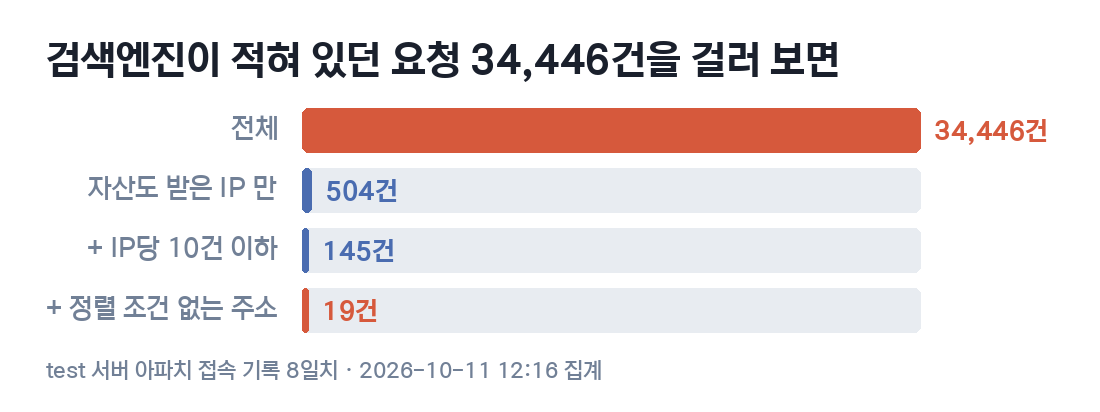
Just looking at the asset requests, 98.5% of them are coming from bots. This doesn't mean the 19 requests that *might* be from people are definitely human. It just means we can't rule out the possibility that they are people yet.
My Blog Traffic from Search is Zero
This server hosts several different sites, and all the access logs get mixed into one file. The numbers I'm seeing are the total for the entire server. So, I pulled out the logs for just my two blogs to see what was going on. I traced them back using the Referrer information provided in the asset requests to see which site and which page they came from.
Over an eight-day period, the search traffic to those two sites was zero. The 34,446 requests were all coming from somewhere else. If I had based my statistics on the Referrer, I would have written that about 4,300 people found me through search every day. In reality, not a single person showed up.
This happened before too. When I checked my server logs against the security advice I often read at kilho.org, and when I recounted after blocking things to see if the scanner traffic went down at kilho.org, I saw the same thing. What seemed correct on the surface was actually wrong on my server. Until I re-measure, I don't know which is the case.
How I Measured It
I read the Apache access logs using the combined format. I processed eight days' worth of data—from the morning of October 4, 2026, through the afternoon of October 11, 2026—which amounted to 1,961,465 lines. I finished the entire aggregation in one pass on October 11, 2026, at 12:16 PM (server time). Since the log file keeps growing, running separate counts for each item would throw off the numbers.
From the Referrer field, I extracted only the hostnames and filtered for those that contained names of search engines. I excluded requests that come along with a page, like images and CSS, because one person might count as multiple hits. This meant I excluded 613 asset requests that shared the same Referrer.
To make sure I wasn't mixing up counting IPs versus counting requests, I first calculated the requests per IP address based on whether the asset was received, and then I applied that to the requests.
What I'll Measure Next
I shut down the xmlrpc.php on this server after finishing the measurement. The next question is where those 224 requests are going. I'll track and compare them in seven days using the same method: whether they stop after getting a 403 error, if they move to a different path, or if they just come back by changing the Referrer.
I haven't tried blocking the range 47.79.0.0/16 yet. It's obvious that blocking it will reduce the requests, but what I really want to know is if the same source just shifts to a different IP range. I'll track that too.
Frequently Asked Questions
Can't you just block requests that don't include a Referrer?
That's not something I can block. This field isn't something my server determines; it's something the requesting party sends. I can't change the text in a request from another party using my server settings. What I can control is how much I trust that text. All four of these criteria don't rely on the Referrer.
Is it possible that the 32,547 requests to the bulletin board are real search traffic?
At first, I doubted that possibility. Since the response code was 200 and it pointed to a legitimate bulletin board URL, it could have been normal traffic from another site. That's why I used all four criteria. About 96% of the traffic was clustered in one range, the traffic was consistent within a 1.27x factor over 23 hours, about nine out of ten requests didn't render any content, and 96.4% of the requests had sorting parameters in the URL. While one criterion alone isn't conclusive, the fact that all four pointed in the same direction was telling.
So, what should I consider the actual traffic?
It's better to trust what the search engines tell you directly. Google Search Console and Search Advisor provide data on impressions and clicks from their end. They aren't just reporting what the request sender claims. If you're looking at server logs, you should also check if they brought along any assets. In this measurement, one of those conditions filtered out 98.5% of the noise.